
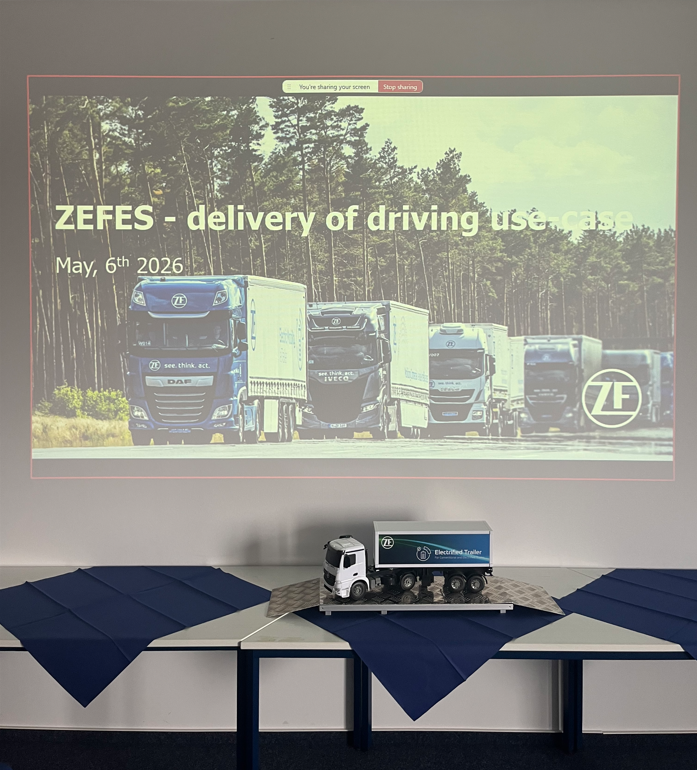
The use of an e-trailer equipped with a traction axle can significantly increase the driving range of a vehicle combination consisting of a battery-electric truck (BEV) and an e-trailer compared with the use of a conventional trailer. Demonstrating this benefit under real operating conditions is an important objective of the ZEFES project. Operation on a cross-border European freight transport route also provides valuable insights into the suitability of charging infrastructure for charging both vehicle units simultaneously.
The ZF e-Trailer Fleet
The ZEFES Partners Kaessbohrer (KAE) and ZF conjointly realized the KAE/ZF e-trailer, by integration of a ZF TrailTrax system to a KAE containerchassis. Special attention was paid to the metal housing of the eBox which hosts the heavy batteries and other TrailTrax system components. The housing of the battery system box was designed, manufactured and tested at Kaessbohrer, to ensure safe, robust and reliable integration of the populated battery system box to the containerchassis. Also, the mechanical robustness of the ZF eAxle and its integration to the Kaessbohrer chassis suspension system was validated under rough conditions. The test had been executed at Kaessbohrer R&D centers and testing ground.
The proper functionality of the TrailTrax system was optimized and tested by ZF. Especially the save interaction of the propulsion and retardation system with the brake system of the trailer and the unproblematic behavior of the towing vehicle has been validated. Finally, ZF achieved the licensing of the e-trailer for operation on public roads (cross border).
At the beginning of March 2026, as the first of three demonstrations with different e-trailers planned for ZEFES, the KAE/ZF e-trailer started trial operation on a route between Eindhoven (Netherlands) and Augsburg (south of Germany). The trial was designed to replicate a real transport roundtrip mission between two DPD distribution centers with a distance of 700 km. The vehicle combination operated at a gross vehicle weight of 36.3 tonnes, including a payload of 19 tonnes.
The KAE/ZF e-trailer successfully demonstrated its operational capability during a condensed six-week testing phase conducted by ZF test drivers. The results collected during the trial are now available internally and are currently being prepared for inclusion in official ZEFES reports.
Preliminary evaluation already shows that the e-trailer battery drains at the same rate as the battery-electric truck’s battery. With a usable battery capacity of 375 kWh in the BEV and additionally used 205 kWh in the e-trailer, the maximum vehicle driving range increased from 280 km for the BEV with a standard trailer to around 420 km with the e-trailer — an improvement of 50%. As a result, only one charging stop is necessary on the route with e-trailer instead of two with BEV and a standard trailer.
To maintain transport schedules, charging times should not significantly exceed the legally required driver rest periods. Achieving this depends largely on charging stations being accessible to the complete vehicle combination and allowing both the truck and the e-trailer to be charged simultaneously while remaining coupled. Smooth payment processes and consistently high charging performance are equally important factors.
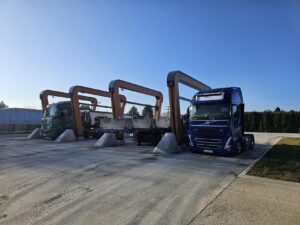
Simultaneous Charging of Truck and Trailer
During the trial, the drivers successfully managed the challenges associated with charging the vehicle combination. Overall, the availability of charging infrastructure was assessed positively, as charging opportunities are becoming increasingly widespread and are progressively addressing the requirements of electrified heavy-duty transport.
However, simultaneous charging of the BEV and the e-trailer while coupled is generally not yet sufficiently considered in current charging station designs, due to restricted charging cable length and inappropriate parking positions for Truck-Trailer combinations for charging. In many cases, the e-trailer had to be uncoupled to position it at the charging point.
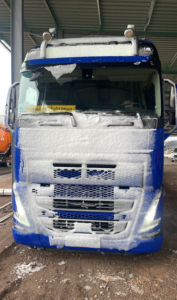
Temporary winter-conditions
Driver’s feedback regarding vehicle handling and overall operability was consistently positive. Because the powered trailer compensates for a large share of its own driving resistance, the vehicle combination feels comparable to operating with a much lighter payload. Throughout the testing period, drivers reported stable and predictable vehicle behavior.
A brief late winter weather event during the trial further highlighted the benefits of the additional propulsion axle in the trailer. The winter conditions also applied additional testing challenges for the TrailTrax system components.
In conclusion, the 10,000 km trial was completed without operational disruptions and without any significant technical issues. The Kaessbohrer Containerchassis e-trailer equipped with the ZF TrailTrax system proved to be a practical solution for fully electric long-haul transport, while further improvements in charging infrastructure are expected to enhance operational efficiency even further.